
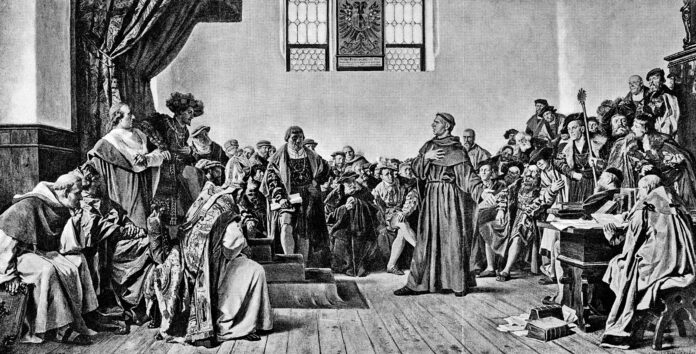
A Catholic Look at Unity, Authority, and the Reformation
You’ll sometimes hear the claim: “Martin Luther brought back the real, biblical Christianity.” It’s an idea that sounds compelling on the surface. But there’s an important question we need to ask:
If Luther truly restored the one true Christian faith, why didn’t all Christians unite under him?
When God restores something, the fruit is unity, not division. Jesus Himself prayed that His followers would be visibly one:
“That they may all be one… so that the world may believe that You sent Me.”
—John 17:21
But the moment Luther rejected the Church’s authority, something new entered Christian life: each individual—no matter how sincere—became his own final interpreter of Scripture.
And once that door opened, it couldn’t be closed again.
What Happened After Luther Broke Away?
Very quickly:
- Zwingli disagreed with Luther on the Eucharist.
- Calvin disagreed with both.
- Anabaptists broke from all three.
- Then came Baptists, Methodists, Anglicans, Presbyterians, Lutherans, Pentecostals…
- And eventually thousands of independent “non-denominational” churches.
Today, scholars estimate over 40,000 Christian denominations and communities around the world.
All sincere.
All reading the same Bible.
All teaching different things.
The early Church Fathers would not have recognized this landscape.
Early Christians Knew Where to Find Unity
From the beginning, Christians believed in a Church with visible authority—one that safeguarded the teaching of the Apostles.
Ignatius of Antioch (A.D. 107), a disciple of John the Apostle, wrote:
“Where the bishop is, there is the Church.”
Irenaeus (A.D. 180), refuting false teachings, didn’t say “read the Bible and decide for yourself.” Instead he pointed to apostolic succession:
“We can enumerate those who were appointed bishops by the Apostles and their successors down to our own day.”
Clement of Rome (A.D. 96), writing to settle a dispute in Corinth, speaks with authority the Corinthians were expected to obey—because the early Church understood authority as Christ-given.
This is the structure that preserved unity.
What Did the Reformation Actually Restore?
If Luther’s goal was unity, history tells a different story.
The fruit of the Reformation was not a united, purified Christianity.
It was fragmentation—the very thing St. Paul warned against:
“I appeal to you… that there be no divisions among you.”
—1 Corinthians 1:10
Rejecting a single, apostolic authority didn’t restore unity.
It removed the very anchor that held Christians together.
Meanwhile, the Catholic Church…
Yes, the Church has sinners. It always has.
Peter denied Jesus.
Paul rebuked Peter.
The Apostles themselves argued over who was the greatest.
And yet—even with human weakness—the Church has remained:
- One
- Holy
- Catholic (universal)
- Apostolic
For 2,000 years, it has continued to preach the same essential doctrines, celebrate the same sacraments, and preserve the same structure Christ established:
“You are Peter, and upon this rock I will build My Church.”
—Matthew 16:18
“He who hears you hears Me.”
—Luke 10:16
The Apostles passed on their authority to the bishops (Acts 1:20–26, 2 Timothy 1:6), and those bishops continue to this day. This isn’t human ingenuity. It’s the guidance of the Holy Spirit:
“The Spirit of truth will guide you into all truth.”
—John 16:13
So Why Isn’t Everyone Lutheran?
Because once the idea of “no visible authority” enters the Christian world, unity unravels. The Reformation didn’t rebuild the ancient Church—it splintered it.
But the Catholic Church continues to stand on the same foundation Christ laid.
Not because Catholics are better, but because Christ is faithful to His promises, and the Holy Spirit protects the Church’s unity in faith.
After 2,000 years, the Church still teaches what the Apostles taught, still celebrates the sacraments they handed down, and still guards the deposit of faith entrusted to them.
The Bottom Line
The question isn’t simply, “Why isn’t everyone Lutheran?”
It’s deeper:
Where can we find the unity Jesus prayed for and the authority He established?
For two millennia, the answer has remained the same:
In the one, holy, catholic, and apostolic Church.

